ant01An anatomical study
Formicidae, no. 001
FIG. 01 — THE BODY AS LANDSCAPE
00 / 06

The unseen

↳ 001

A body, almost absent.

Move your cursor over the ant.

Reveal what lies beneath the surface. Choose a layer and select a part to look closer.

WORKER · WINGLESS FEMALESchematic anatomy
Revealing the study …
100%
Drag to rotate.Scroll to explore below.
28
00
Beyond the body Scroll to explore ↓
ant / field notes00%
02 / BEYOND THE BODY

One family.
Many ways to live.

The ant above is a study of a shared body plan. Outside that body is a much larger story: thousands of species, different societies, and a history that reaches back into the age of dinosaurs.

Some ants weave leaves into rooms. Some grow their own food. Others build temporary shelters from their living bodies. Explore a selection of those lives below.

A selected introduction, not a complete catalogue. Explore the AntWeb catalogue ↗

03 / SPECIES REGISTER

Ten lives,
closer to the ground.

A selection of living species. Common names can cover more than one species; the scientific names below identify the particular ants in this register. Open a name to read its field notes.

10 species

Habitat filters describe broad settings, not complete distribution maps. The interactive anatomy above is schematic and does not change species when a field note is opened.

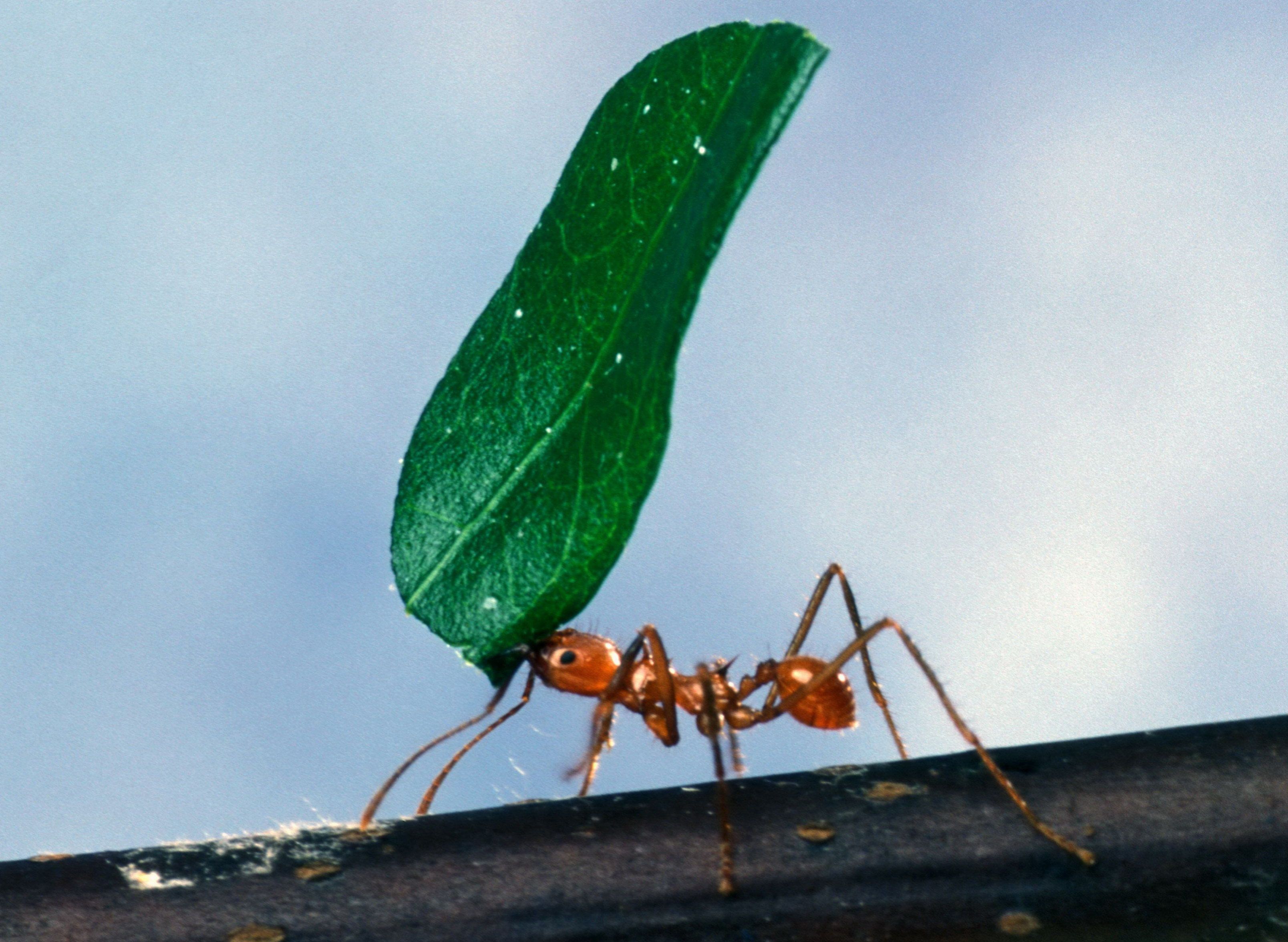
A leafcutter ant carrying a green leaf fragment along a branch
Leafcutter worker carrying vegetation. Photograph: Scott Bauer / USDA, public domain. Original photograph ↗
FIELD NOTE / AGRICULTURE

The leaf
is for
the garden.

Leafcutter ants collect plant material to feed cultivated fungi inside the nest. Their crop is a living partner, tended by workers and passed between generations of colonies.

Leafcutters are only one branch of a wider history of fungus farming. A 2024 evolutionary study placed the origin of ant agriculture at around 66 million years ago, near the end-Cretaceous mass extinction.

Smithsonian / the origins of ant agriculture ↗
04 / DEEP TIME

Older than
our world of cities.

Fossils preserve the bodies. DNA helps reconstruct the family tree. Together, they reveal a history with extinct branches, changing environments and many surviving experiments.

CRETACEOUS

Ants among dinosaurs

Ants appear in the Cretaceous fossil record, long before humans. Some early fossil ants belong to extinct branches outside the group containing all living ants. They were not simply modern garden ants trapped in resin.

AntWeb / fossil ants ↗
MID–LATE CRETACEOUS

Early societies

Fossils of early ants, including Gerontoformica, provide evidence of social behaviour. Researchers study specimens preserved together and anatomical features to investigate how cooperation evolved. A fossil is evidence to interpret, not a complete recording of a colony.

Research / sociality in stem ants ↗
~66 MILLION YEARS AGO

The beginnings of farming

A dated evolutionary analysis links the beginnings of fungus cultivation to the period around the asteroid impact that ended the age of non-avian dinosaurs. This is an inferred evolutionary date, not the age of a directly observed garden.

Smithsonian / 2024 study ↗
EOCENE → PRESENT

Many branches flourish

Modern ant lineages diversified as environments changed. The living family includes hunters, scavengers, seed collectors and farmers. Evolution is a branching tree: no living species is the final or most advanced ant.

PNAS / the evolution of ant life cycles ↗

Dates and relationships can change as new fossils and genetic evidence are studied.

05 / THE COLLECTIVE

A colony has no
control room.

The queen reproduces; workers respond to one another and to local conditions. There is no central director.

01

The queen

Her central role is reproduction. A colony may have one queen or several, depending on the species and colony structure.

02

The workers

Female workers care for brood, maintain the nest, forage and defend it. Tasks change with age and colony needs.

03

The males

Males mate. They usually appear seasonally and do not perform the workers’ daily tasks.

04

The brood

Eggs, larvae and pupae depend on care. Together, these developing stages form the brood.

ASU / colony organisation ↗
06 / AN INVISIBLE LANGUAGE

A trail you
cannot see.

Antennae read chemical information. To an ant, a surface can hold clues about food, danger and the identity of a neighbour.

Follow.

Trail pheromones

In trail-laying species, workers deposit chemical signals that other ants can follow. As successful routes are reinforced, a collective trail can emerge from individual decisions.

Recognise.

Colony identity

Chemicals on the body help ants distinguish nestmates from outsiders. Recognition depends on sensory information rather than a visual uniform.

Respond.

More than scent

Ants also use touch, and some communicate through vibration. The signals and their importance vary between species and situations.

ASU / ant communication ↗ · Research / Argentine ant trail formation ↗

07 / PLACES TO LIVE

A world beneath.
A world above.

THE FOREST FLOOR

Wood, litter and mounds

A fallen branch can be shelter. Leaf litter can be a hunting ground. Wood ants such as Formica rufa gather needles, twigs and other plant material into conspicuous mounds. The nest is part of the surrounding forest, connected to food sources by foraging trails.

Wood ant natural history ↗
THE CANOPY

Rooms made of leaves

Asian weaver ants pull living leaves together and use silk produced by their larvae to join them. Workers contribute both labour and living tools. A colony can occupy several leaf nests across trees, making the canopy an interconnected home.

Weaver ant nesting ↗
DRY LANDSCAPES

Storing for lean times

Some honeypot-ant workers become repletes: their gasters expand as they store liquid food for the colony. Food held in living bodies can later be shared with nestmates. This strategy has evolved in more than one ant group.

Living food stores ↗
THE SOIL

Small animals, large effects

Ants are part of a much wider underground community. Their hunting and nest building connect them to other invertebrates and the soil around them. Understanding an ant means looking beyond the colony to the ecosystem it inhabits.

Natural History Museum / life in soil ↗
08 / THE NEXT GENERATION

One life.
A complete transformation.

The individual changes shape; the colony provides continuity. Mating begins the reproductive story, followed by the four developmental stages: egg, larva, pupa and adult.

ASU / the ant life cycle ↗
09 / LOOK AGAIN

Things worth
getting right.

Are flying ants a different species?

Usually, they are winged reproductive individuals: young queens and males. Workers are wingless. Several species may take mating flights in the same season, so “flying ant” is not a species name.

Natural History Museum ↗
Do carpenter ants eat wood?

Carpenter ants excavate wood for nesting. The wood is a building material, not their diet in the way it is for wood-eating termites. Camponotus herculeanus, for example, also visits aphids for honeydew.

Species account ↗
Does every colony have soldiers?

No. Worker size and shape differ between species. Some have clearly differentiated large workers; others do not. “Soldier” does not describe a universal extra caste present in every ant colony.

ASU / worker castes ↗
Can I identify an ant by its colour?

Colour alone is rarely enough. Identification may require the shape of the waist, antennae, hairs and other small features, together with location. The scientific references in the register include identification information; this atlas is not an identification key.

Explore scientific specimens ↗
Are all ants helpful wherever they live?

Ecological effects depend on context. An ant can be part of its native ecosystem and disruptive when introduced elsewhere. The Argentine ant illustrates why native range and introduced range must be considered separately.

Argentine ant species account ↗
Is the ant at the top a real scan?

No. It is an artistic anatomical study made from calculated points. It shows a shared body plan and simplified organs. Species in the register can differ considerably in proportions, waist segments, jaws and other features.

Return to the anatomical study ↑
10 / KEEP LOOKING

Start with
the next ant you see.

Follow its route for a moment. Notice what it carries, where it disappears, and which other ants it meets. A small observation can open a much larger question.

A NOTE ON THE STUDY

No bones.
An exoskeleton.

The ant’s hard outer surface is its skeleton. Made of chitin, it protects the organs and provides attachment points for muscles on the inside.

This is an artistic, schematic interpretation. The points are calculated from geometric forms, not a scan. Internal organs are simplified and emphasised so they can be explored.

Explore: Drag to rotate; use + / − or pinch to zoom. Scroll to explore the atlas below. Choose an anatomical layer and click the ant. Use the slider to separate its parts.

ASU — anatomy ↗ASU — life cycle ↗
FROM MATING TO COLONY
01